

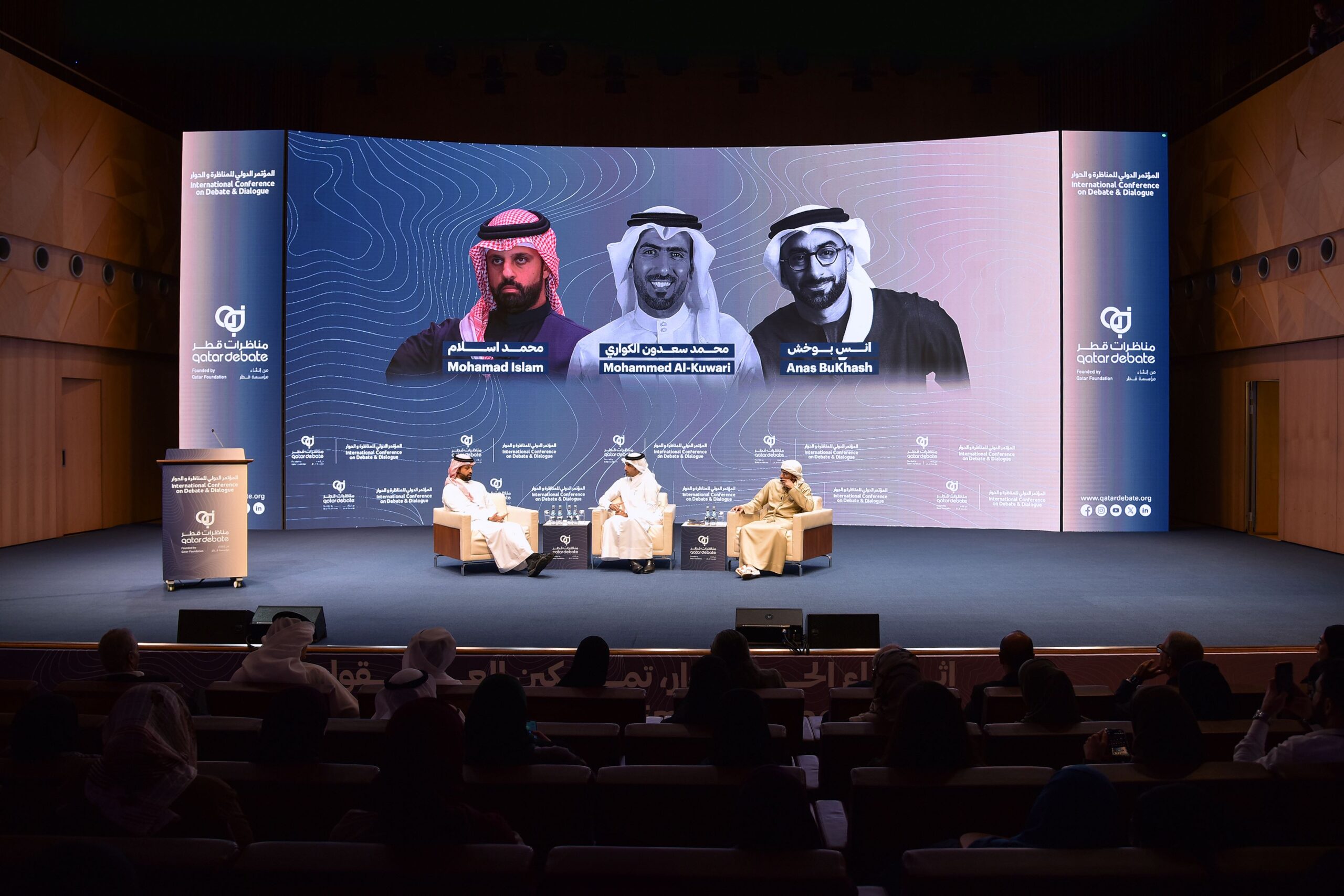
A Concluding Panel Session with Anas Bukhash, Mohammed Islam and Mohammed Saadon Alkuwari
Doha, Qatar – 20 May 2025 – QatarDebate Center, a member of Qatar Foundation, concluded the second edition of the “International Conference on Debate and Dialogue” this evening. The two-day event brought together approximately 1,200 participants, including leading thinkers and academics from diverse disciplines representing over 36 countries. The conference also welcomed participants from prestigious universities worldwide that integrate debate into their curricula and cultural activities, alongside representatives from civil society organizations actively engaged in community building, promoting values, and raising awareness, particularly among younger generations.
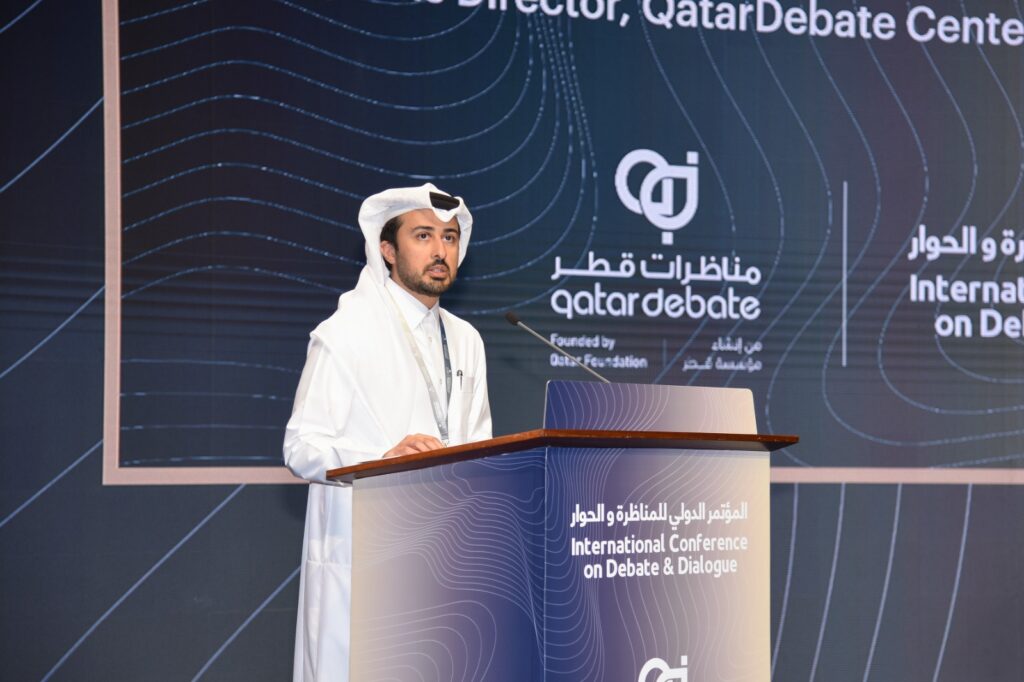
During the closing ceremony, Abdulrahman Al-Subaie, Programs Director at QatarDebate Center, praised the caliber of attendees and the quality of contributions. He emphasized that the conference “serves as an important opportunity for researchers in the fields of dialogue, debate, and human communication to present research papers that are the product of efforts across all sectors related to debate as an ancient art, and dialogue as a noble form of communication.”
Al-Subaie highlighted that this conference aligns “with the pioneering role of the State of Qatar as one of the largest global incubators for dialogue and negotiation for peace, security, and justice. Thanks to God, Qatar’s efforts have achieved global accomplishments that have contributed to establishing peace and aiding those threatened in dangerous and conflict-ridden environments.”
He continued, “We are in a time where it is not enough to simply be right; you must champion the right. It is not enough to seek the truth; you must also desire it. Similarly, it is not enough to be righteous; you must also be a reformer.” Al-Subaie concluded his speech by thanking Qatar Foundation and all partners who support QatarDebate Center’s mission, commending the significant impact the center achieves at both regional and global levels.
The conference activities culminated in a general dialogue session featuring media personalities Anas Bukhash, host of “ABTalks,” and Mohammed Islam, host of “Mo Show,” moderated by journalist Mohammed Saadon Al-Kuwari. The session focused on “Innovators in Media: Diversity of Methods, Integration of Goals.”
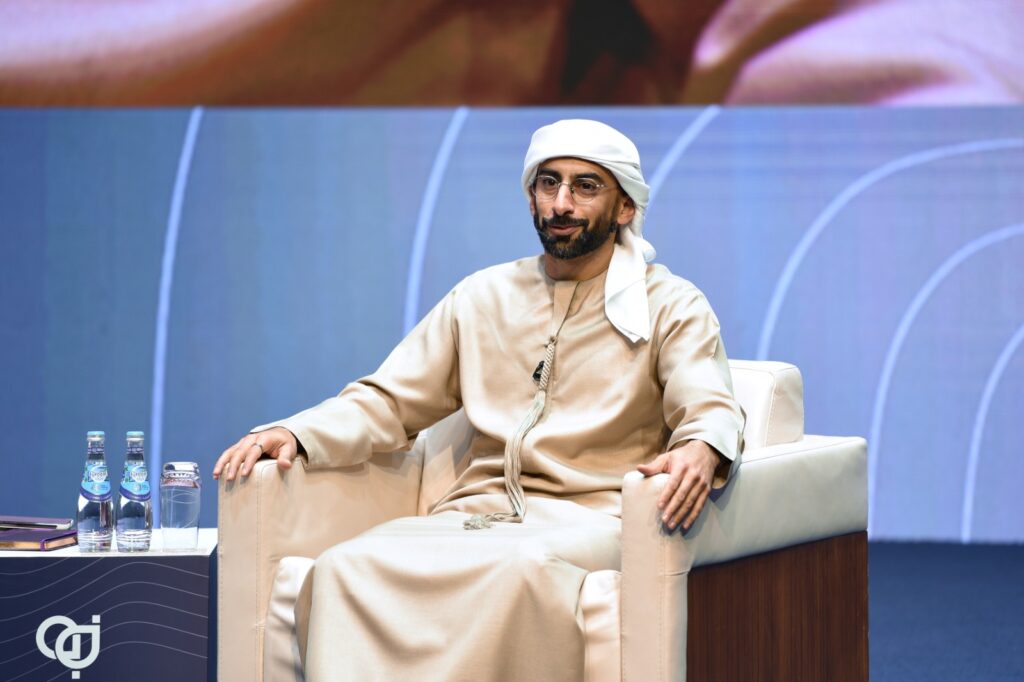
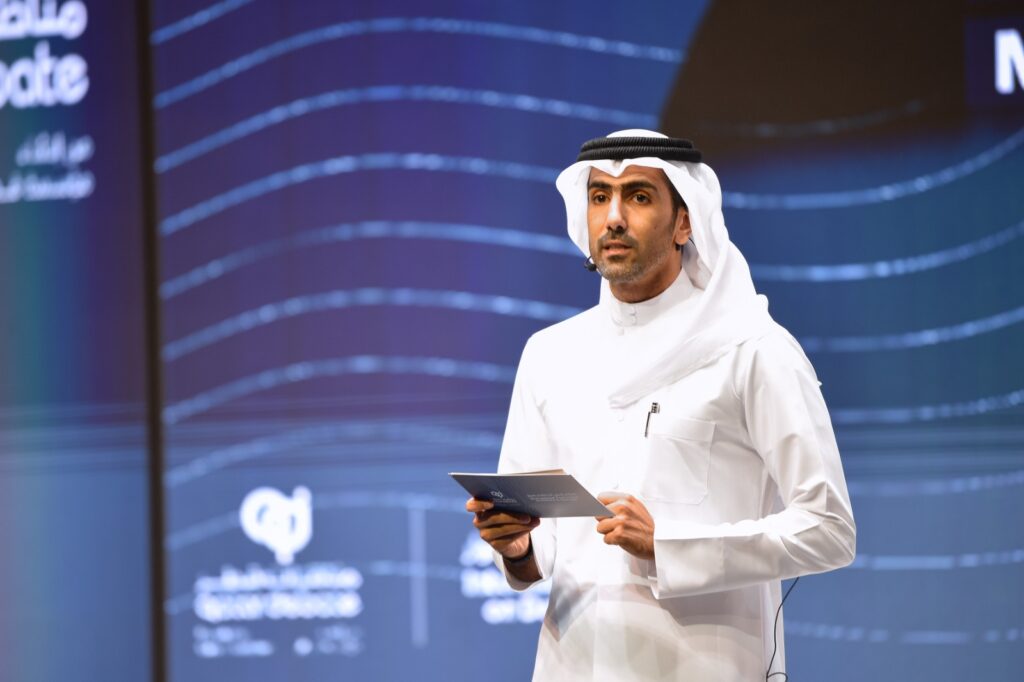
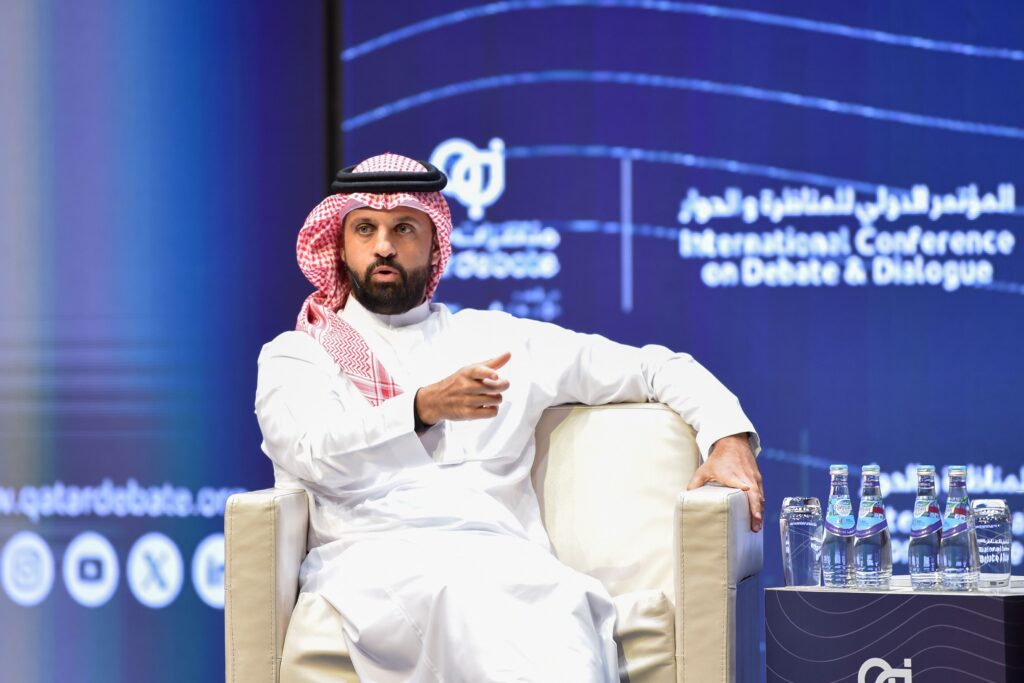
The speakers discussed the differences in their approaches and the diversity of their content, while also highlighting their shared goals of breaking stereotypes, promoting transparency, and building trust in societies still adhering to traditional forms of expression. The audience also had the opportunity to participate in an open discussion segment, where questions were asked and opinions exchanged.
The closing day also saw the recording of special podcast content in collaboration with media partner “Doha Plus,” as part of efforts to document the conference outcomes and expand the scope of purposeful discussions.
The second day of the conference was filled with in-depth discussions during its parallel sessions, addressing intellectual and societal issues from multiple perspectives. Notable sessions included “The Peer-Reviewed Journal – Informal Logic,” which presented selected scientific papers with specialized commentaries; “Argumentation: Arab and Islamic Perspectives,” which reviewed the Arab heritage in this field; “The Impact of Debate on Enhancing Critical Thinking and Language Learning,” which highlighted the educational dimension of debate; and “Islamic Argumentation: Figures and Methodologies,” which showcased pioneers of debate in Islamic heritage. Additionally, a distinguished youth workshop titled “Dialogue and Youth Voices” was held.
Professor Hammou Nakari, Professor of Philosophy and Logic from Morocco, delivered the keynote address on the second day titled “Debate Logic.” He explored the rich heritage of debate and its regulations in Arab Islamic thought, and presented a contemporary vision for integrating this legacy with modern theories in argumentative logic, informal logic, and critical thinking logic.
Professor Nakari’s lecture was based on four fundamental pillars that distinguished the logical debate material in Islamic-Arab heritage: the originality of debate as a methodology, the concomitance of valid reasoning with its freedom from opposition, the legitimacy of the right to object as a basis for constructive dialogue, and the obligation to respond according to a system of defined logical and ethical conditions.
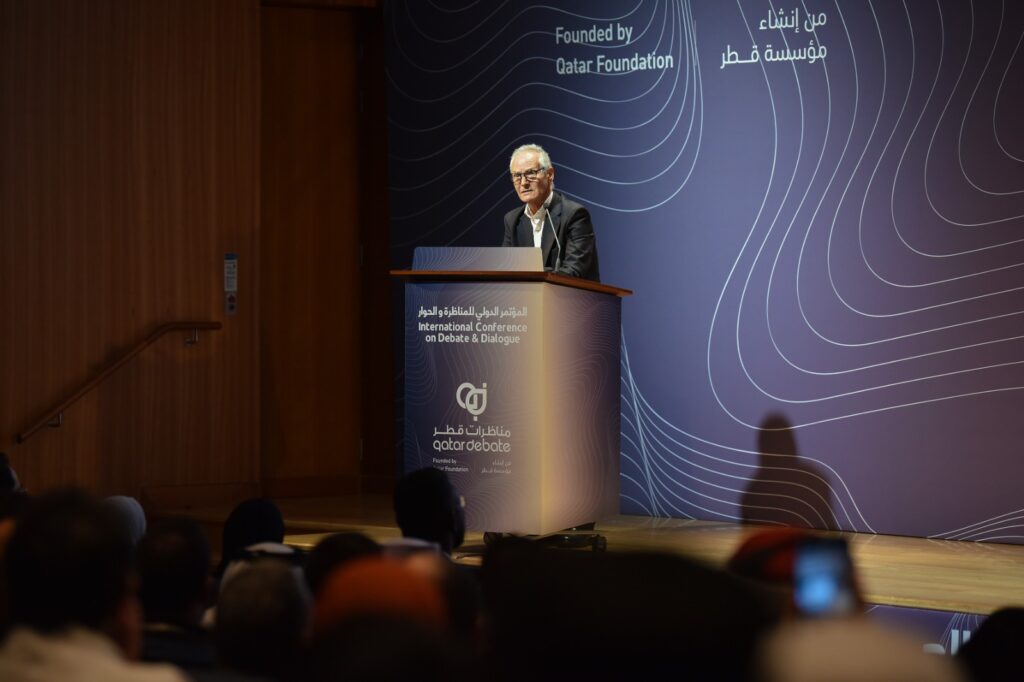
Specialized sessions resumed in the evening, where participants discussed contemporary topics such as “Utilizing Artificial Intelligence in Argumentation: Limitations and Potentials,” which explored the relationship between modern technologies and the art of debate; “Reimagining Education Through Debate: Insights and Case Studies,” which presented practical experiences; and “Argumentative Practice: Building Resilience, Effectiveness, and Inclusive Dialogue,” which addressed dialogue skills. Additionally, sessions included “Behind the Scenes of Judging: Exploring Debate Judging Practices and Philosophy,” which revealed the secrets of evaluation, and “Standard Arguments in Islamic Jurisprudence and Contemporary Legal Logic: Deduction and Falsifiability,” which combined authenticity and modernity.
It is worth noting that the conference aims to foster intellectual dialogue and exchange experiences among participants from various parts of the world, in pursuit of developing mechanisms for debate and argumentation in various scientific and societal fields.
Leave a comment